Winding Tools
As we know, AC motors are present in every area of our lives. Three-phase motors are extremely simple and need very little to run for long periods of time. In homes, however, where a three-phase supply is not usually available, single-phase motors are needed. Today countless appliances have small motors inside (pool pumps, fridges, vacuum cleaners, drills, etc.), and except in very specific cases they run on alternating current.
Single-phase motors can be divided into three main families (although there are more):
The most important of these, mainly because they are usually the most powerful, are the auxiliary winding motors. They are also almost identical to three-phase motors in mechanical construction and winding principles, although a single-phase motor can never run on a pure three-phase supply. These single-phase motors therefore consist of a slotted stator and a squirrel-cage rotor. We will focus on this type of motor.
Consider a slotted stator with a single winding fed from a single-phase supply. Depending on the type of winding, n poles are created. They reach their maximum value when the current in the winding is at its maximum, then drop to zero and later reach a maximum again, this time negative: a typical sinusoidal behaviour. But these magnetic fields are static; they do not rotate as described in Fundamentals of induction motors. As a result, far from turning, the rotor tends to stay still and may even vibrate slightly. Be careful: under these conditions the winding can burn out.
Suppose, on the other hand, that the motor is already turning at its rated speed. Applying Fleming's right-hand rule, we see that currents flow through the squirrel-cage conductors of the rotor, and these currents create a magnetic flux at 90° to the one created by the stator, which keeps the motor turning. In short, a single-phase motor cannot start by itself, but once it has started it can keep turning on its own.
To start this type of motor we use an auxiliary (or secondary) winding. This winding occupies only 1/3 of the total stator space and is placed 90 electrical degrees apart from the main winding. The cross-section and number of turns of the auxiliary winding depend on whether it stays connected permanently or only works during starting. Most commonly it stays connected permanently; when it does not, it works temporarily and is disconnected once the motor reaches its speed, either by a timer or by a centrifugal switch.
In a single-phase motor of this type, the direction of rotation is reversed by swapping the leads of just one of the windings.
This type of motor is perhaps even simpler than the previous one, but this simplicity reduces its performance and therefore its range of applications. Like the auxiliary winding motor, it has a squirrel-cage rotor, but the stator has salient poles, like DC motors, and each pole carries a short-circuited turn (shading coil), usually made of copper, covering about one third of the pole arc.
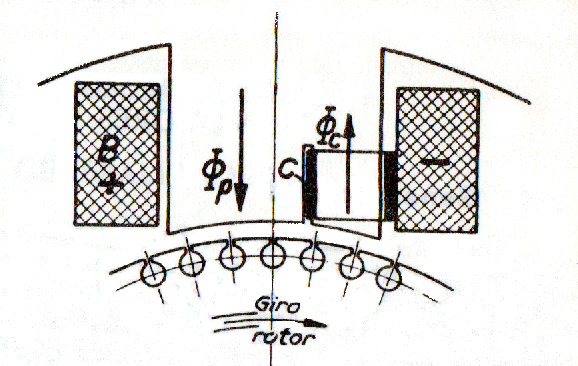
In a salient-pole motor, simply energising the pole coils does not make the rotor turn; the short-circuited turn on each pole distorts the lines of force and makes the motor start. This happens because a flux out of phase with the main pole flux is generated in the shading coil. The motor always turns towards the side where the shading coil is, so the only way to reverse the direction of rotation, if needed, is to mount the stator the other way round, if that is possible.
This is the name given to the motor that can run on both DC and AC. To do so it has a salient-pole stator and a wound rotor with brushes, with both windings connected in series. It has a high starting torque and its speed is inversely proportional to the load, reaching very high speeds when running with no load. It is widely used in small machines such as drills, angle grinders, hair dryers, etc., but its service life is relatively short.

 Español
 Français
 Português
 Deutsch
 Italiano
 Polski
 Türkçe